Voltage Tester Pen or Voltage Detector? Choosing for Low Voltage

A non-contact voltage tester pen finds live circuits quickly but cannot prove dead. Pen vs two-pole detector vs multimeter, CAT ratings and the live–dead–live check.
The short answer: a non-contact voltage tester pen is very useful for quickly finding out whether a cable or terminal is live, but on its own it is not sufficient to prove that a circuit is dead. The UK Health and Safety Executive's (HSE) guidance note GS38 recommends that single-pole and non-contact detectors be used only to identify live equipment, and that devices which make contact with the conductor be used to prove dead. At low voltage, the accepted tool for this job is a two-pole voltage detector conforming to IEC/EN 61243-3.
In this article we compare the voltage tester pen, the two-pole detector and the multimeter in terms of selection, CAT rating and proving dead. For the technical difference between the detection principles, see our article on contact vs non-contact voltage detectors.
Tester pen, two-pole detector and multimeter: what is each for?
All three devices deal with "voltage", but on site they answer different questions:
| Non-contact / pen-type voltage tester | Two-pole voltage detector | Multimeter | |
|---|---|---|---|
| Question it answers | "Is there voltage here?" | "Is there no voltage between these conductors?" | "How many volts?" |
| How it works | Senses the electric field around the conductor, usually through the insulation | Makes contact with the conductors via two probes | Measures on the selected function and range |
| Relevant standard | For safety, the IEC 61010 series (per manufacturer's declaration) | IEC 61243-3 (up to AC 1000 V and DC 1500 V) | IEC 61010 series |
| Strength | Fast scanning, picking out a cable in a bundle | Designed for checking the dead state | Measuring values, fault finding |
| Weakness | May not detect on screened cable, in metal conduit or on DC | Not designed for use in rain or for continuous operation | Choosing the wrong function or range can cause accidents |
| Proving dead | Not suitable | Suitable (with tests before and after) | GS38 recommends a test lamp or two-pole detector instead |
According to GS38, for tests that only establish the presence or absence of voltage, a test lamp or two-pole detector suited to the system voltage should be used instead of a multimeter. The guidance stresses that the use of incorrectly set multimeters for this purpose frequently causes accidents.
Why can a non-contact tester pen not prove dead?
When a tester pen stays silent there can be several explanations, and only one of them means "the line is dead":
- The field cannot be sensed: In screened cables and conductors inside metal conduit, the electric field may not reach the outside.
- The voltage is DC: Pens designed only for AC give no warning on DC circuits.
- The sensitivity is unsuitable: A pen set to low sensitivity may not respond at low voltage.
- The device is not working: A pen with a flat battery or a fault stays silent on a live line too.
GS38 states this last point explicitly: any device used to prove dead may itself fail to show the hazard, so it should be tested before and after use on a proving unit or a known live source of similar voltage.
How to use a non-contact voltage tester pen
Using a pen correctly starts with giving it the right job: rapid detection and preliminary checks. The recommended steps are:
- Visual check: There should be no cracks in the body, no broken tip and no loose battery cover.
- Test on a known source: Try the pen on a socket you know to be live, or on a voltage detector tester.
- Adjust the sensitivity: With cables laid side by side, the field of the neighbouring circuit can cause a false warning. On models with sensitivity adjustment, reduce the sensitivity to pick out the target cable.
- Bring the tip close to the conductor: The tip rests on the cable sheath or the insulated part of the terminal; there is no need to touch the bare conductor.
- Interpret the result: If there is a warning, the line is live. If there is no warning, that only means "the pen did not detect anything".
- Test again: At the end of the job, check the pen again on the known source.
What do CAT II, CAT III and CAT IV mean?
Measurement categories are defined in the IEC 61010 series according to where in the installation the measurement is made and the overvoltage expected there. The current definitions are in IEC 61010-2-030:2023. According to the GS38 summary based on BS EN 61010:
- CAT IV: Measurements made at the source of the low-voltage installation (meters, primary overcurrent protection devices).
- CAT III: Measurements made in the building installation (distribution boards, socket outlets, fixed equipment).
- CAT II: Measurements on circuits directly connected to the low-voltage installation (household appliances, portable tools).
Together, the category and the nominal voltage determine the transient overvoltage the device must withstand. Some of the values in a Fluke application note summarising IEC 61010 test values are:
| Category and working voltage | Peak impulse voltage | Test source impedance |
|---|---|---|
| CAT II 1000 V | 6000 V | 12 Ω |
| CAT III 600 V | 6000 V | 2 Ω |
| CAT III 1000 V | 8000 V | 2 Ω |
| CAT IV 600 V | 8000 V | 2 Ω |
| CAT IV 1000 V | 12000 V | 2 Ω |
The important detail in the table is the impedance: CAT II 1000 V and CAT III 600 V are tested with the same 6000 V impulse, but because the CAT III source impedance is much lower, it carries much more energy. In other words, "1000 V" on the label does not on its own mean safer. GS38 also lists using a CAT II device on a CAT III installation among the causes of accidents, and requires confirming before testing that the instrument, leads and clips are suitable for the category of the installation. It recommends that exposed metal on probe tips should not exceed 4 mm, and preferably 2 mm.
Live–dead–live: how is dead proved?
Proving dead is a procedure rather than a single measurement. EN 50110-1 requires the absence of voltage to be verified on all poles at or as close as practicable to the work location, and the detector to be tested immediately before and after use. In practice the sequence is:
- Isolate the circuit, lock it off against re-energisation and tag it.
- Live: Test the two-pole detector on a proving unit or a known live source.
- Dead: At the point of work, check all conductor combinations, including phase–neutral, phase–earth and neutral–earth.
- Live: Test the detector again on the known source. If this step is skipped, a "no voltage" result from a device that failed during the measurement goes unnoticed.
- Where necessary, carry out earthing and short-circuiting and cover adjacent live parts.
The tester pen still has a place in this sequence: it is a useful second check for finding the correct circuit before locking off, and for noticing unexpected voltage during the work.
When are HASEGAWA low-voltage detectors used?
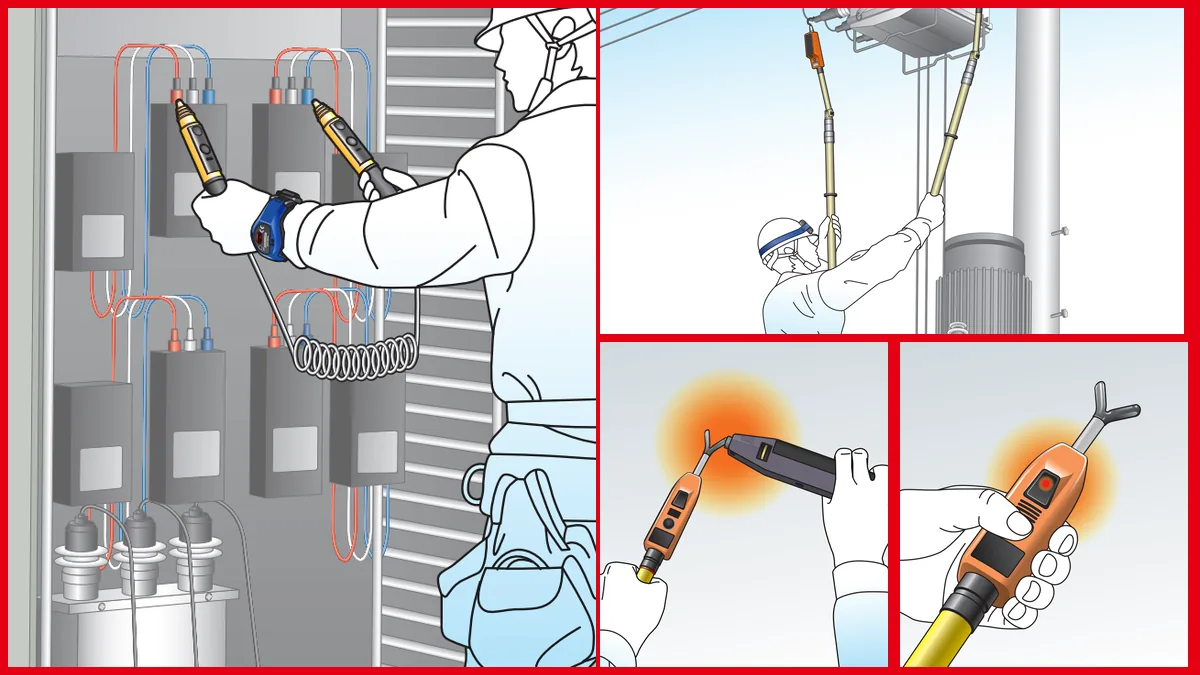
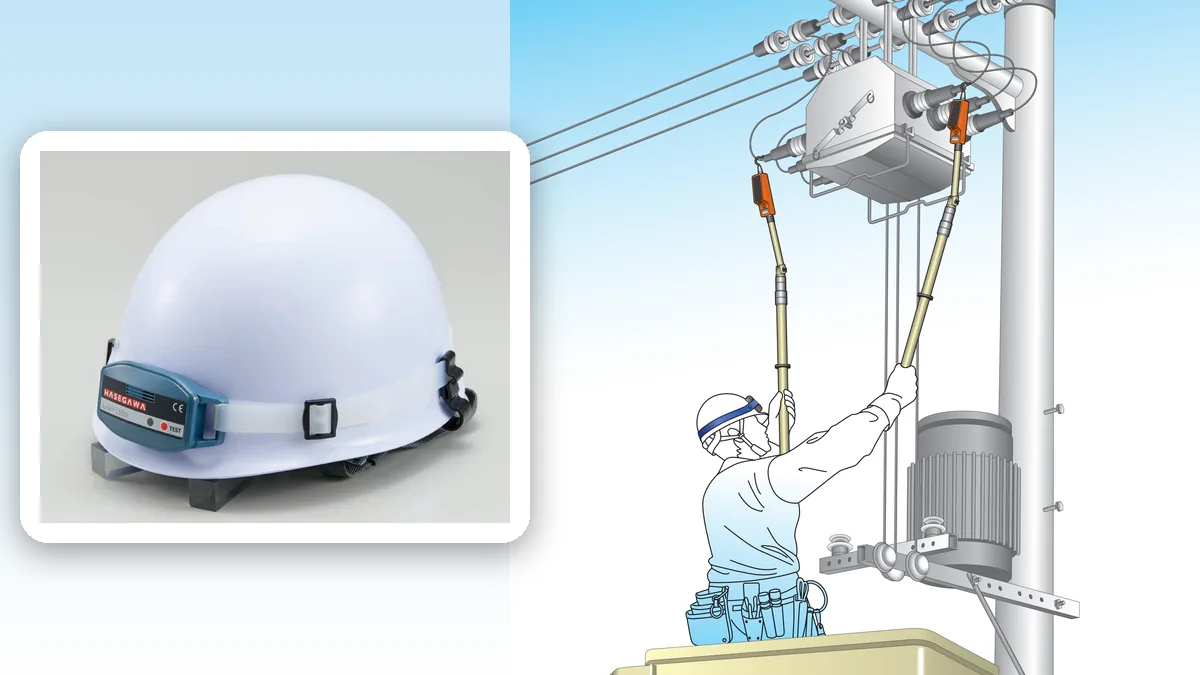
HASEGAWA's low-voltage detectors are pen-type devices designed for detection and preliminary checks:
- HTE-610W: AC 50 V – 1000 V, detection through insulated cable sheaths, adjustable sensitivity. According to the product data it is equivalent to IEC 61010-1 CAT III 1000 V, with an impulse withstand of 8000 V, 10 cycles; this matches the CAT III 1000 V impulse voltage in the table above.
- HTE-610WL: The same detection values as the HTE-610W plus an LED torch that switches off after about 30 seconds; suitable for dark panels and night-time fault crews.
- HTE-700D/700DL: Detects AC 50 V – 600 V and DC 12 V – 750 V. An earth lead is required for DC detection and for AC 80 V and below. It offers IPX4-equivalent protection and an operating temperature down to −10 °C; the DL version has LED lighting. Our product data does not state a CAT rating for this model.
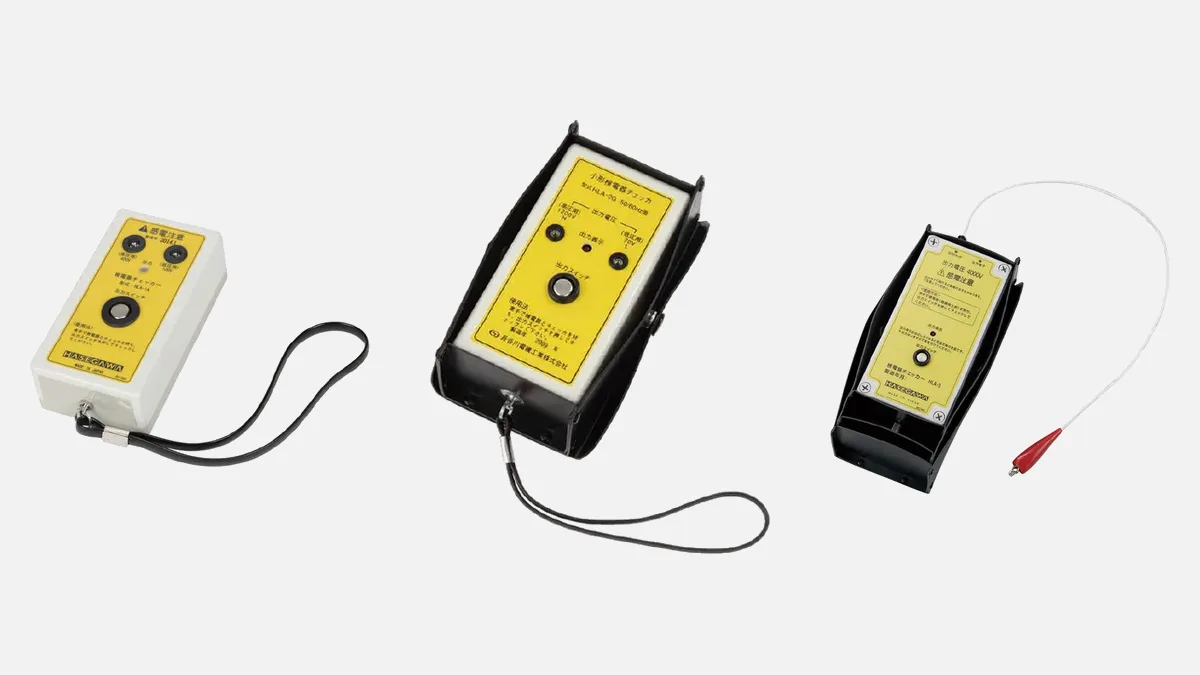
To confirm on site that the pens are working, the HLA-1A tester for low-threshold detectors can be used. For choosing the right detector, see also our voltage detector selection guide.
Related guides: the IEC 61243-1 standard, the five safety rules for electrical work.
Frequently Asked Questions
If the tester pen is silent, can I touch the cable? No. Silence can be caused by a screened cable, DC voltage, low sensitivity or a device fault. First isolate and lock off the circuit, then carry out a live–dead–live check with a two-pole detector.
Does a voltage tester pen detect DC voltage? Most pens are AC only; for example, the operating range of the HTE-610W is AC 50 V – 1000 V. The HTE-700D/700DL detects in the range DC 12 V – 750 V when its earth lead is connected.
CAT III 1000 V or CAT IV 600 V? Look at the highest point in the installation where the device will be used. At the meter and primary protection end, CAT IV is required. At distribution board and socket level, CAT III is sufficient. According to the Fluke summary, both categories are tested with an 8000 V impulse.
Can a multimeter be used to prove dead? For simply checking the presence or absence of voltage, GS38 recommends a test lamp or two-pole detector instead of a multimeter; choosing the wrong function or range can cause serious accidents.
If you would like help identifying the right low-voltage detector for your team, contact us via the quote form.
Sources
- GS38 (4th edition, 2015) – Electrical test equipment for use on low voltage electrical systems – HSE
- IEC 61243-3:2014 – IEC Webstore
- IEC 61010-2-030:2023 – IEC Webstore
- Where safety is built in (measurement categories and impulse values) – Fluke
- Voltage Detectors brochure (testing before/after use under EN 50110-1) – DEHN