Voltage Detector Testers: How to Check a Voltage Detector Before Use
What a voltage detector tester does, which HASEGAWA HLA model suits which detector, and how to check a detector before and after use.
A voltage detector's "no voltage" result only means something if the detector works. A weak battery, a broken connection after a drop or moisture can make a detector show a live conductor as dead. The most practical safeguard is to check the detector with a voltage detector tester before and after every use, as the live–dead–live principle requires.
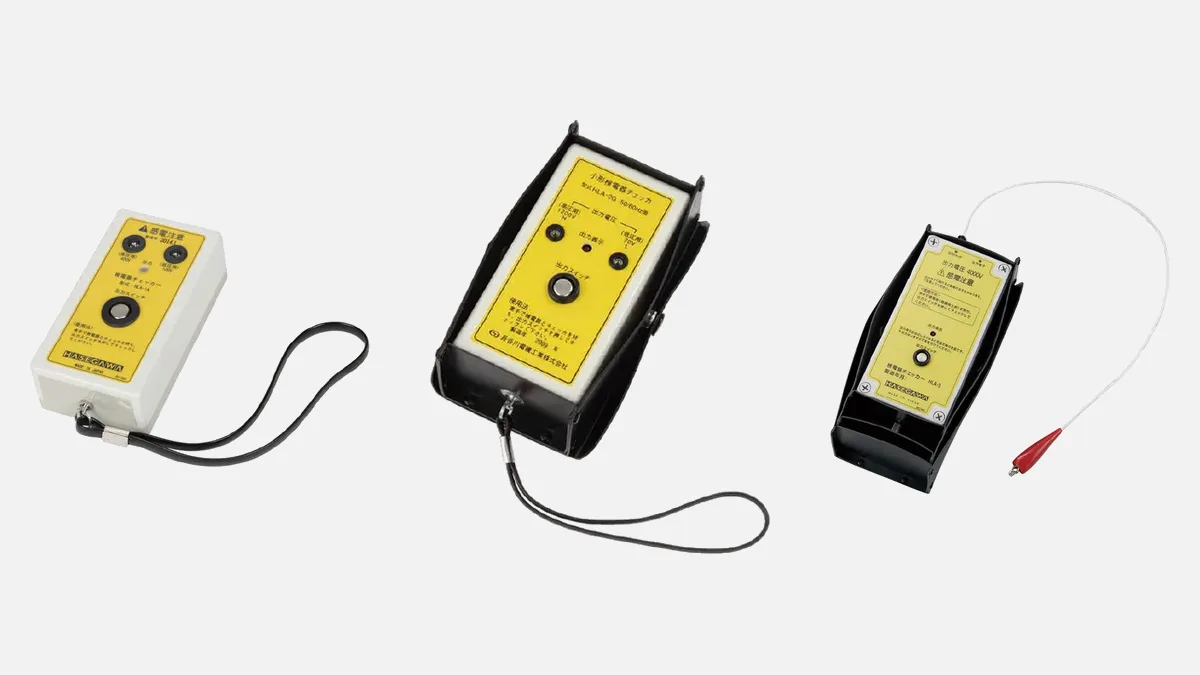
This guide explains what a voltage detector tester does, how the HASEGAWA HLA models differ, and which tester can check which detector.
What is a voltage detector tester?
A voltage detector tester is a small battery-powered source that applies a controlled, current-limited test voltage to the contact electrode of a detector. If the detector gives its visual and audible indication, its sensing circuit, indicators and battery are working. On the HLA series the short-circuit current is 0.5 mA or less.
With a tester you do not need to find a known live part to prove your detector; the check can be done at the vehicle, at the substation door or in the workshop.
The HLA range
| Model | Test voltage | Frequency | Battery | Weight |
|---|---|---|---|---|
| HLA-1A | H: AC 400 V, L: AC 100 V | 55 Hz ± 10 Hz | 4 × LR03 (1.5 V), about 1 h | 430 g |
| HLA-2G | H: AC 1200 V, L: AC 70 V | 55 Hz ± 10 % | 2 × 9 V (6R61 / 6F22), about 2 h | 700 g |
| HLA-3 | AC 4000 V ± 15 % | 55 Hz ± 10 Hz | 2 × 9 V (6LR61 / 6LF22), about 2 h | about 1200 g |
| HLA-N2 DC | DC 1000 V (load ≥ 50 MΩ) | – | 4 × LR03 (1.5 V) | 280 g |
On HLA-3 the output lamp goes out when the battery is weak; use 6LR61 or 6LF22 batteries, not 6F22.
Which tester for which detector?
The rule: the tester's output, including its tolerance, must exceed the upper limit of the detector's threshold voltage, and it must match the type of voltage (AC or DC) the detector is designed for. Examples based on our product data:
| Detector | Threshold voltage | Suitable tester |
|---|---|---|
| HTE-610W (LV, 50–1000 V) | At most AC 40 V at highest sensitivity; operates at AC 200 V at lowest | HLA-1A (L: 100 V at high sensitivity, H: 400 V at low sensitivity) |
| HSE-7G (60 V – 7 kV) | LV: 60 V, HV: 400 V | HLA-2G (L: 70 V for LV, H: 1200 V for HV) |
| HSF-11 (80 V – 11.4 kV) | LV: 65 V ± 15 V, HV: 2000 V ± 200 V | HLA-1A (100 V) for LV, HLA-3 (4000 V) for HV |
| HST-30L (3–34.5 kV) | 500 V ± 100 V | HLA-2G (H: 1200 V) or HLA-3 |
| HST-20N (3–25 kV, AC/DC) | 1000 V ± 20 % | HLA-3 for the AC check |
| HVC-750N3 (DC 600 / 750 / 1500 V) | DC 300 V ± 20 V | HLA-N2 DC (DC 1000 V) |
| HVC-1.5N3 (DC 1500 V) | DC 750 V ± 50 V | HLA-N2 DC (DC 1000 V) |
| HSR-1.5NR (DC 1000–7000 V) | DC 750 V ± 100 V | HLA-N2 DC for the DC function |
Because the LV threshold of HSF-11 can be as high as 80 V within tolerance, the 70 V L terminal of HLA-2G is not enough for it; use the 100 V output of HLA-1A. For high-voltage detectors with thresholds of several kilovolts (for example 3000 V ± 600 V on HST-70L or 5000 V ± 1000 V on HST-W80L), the tester's own tolerance must also be taken into account; follow the manufacturer's recommended test method for these models. Ask us about any combination you are unsure of.
Checking a detector step by step
- Check the tester. Confirm the battery is good and the output lamp lights.
- Switch on the detector. If it has a self-test button, use it first.
- Earth connection. If the detector has an earth lead or clip, connect it as the instructions require.
- Contact. Touch the detector's electrode on the correct output terminal (H or L) and press the output button.
- Confirm the indication. A visual and audible indication means the detector works. If there is none, or it is weak, do not use the detector; replace the battery and try again, and withdraw it from use if the fault persists.
- Repeat after the job. Check again after verifying absence of voltage, to prove the detector did not fail during the test.
A tester does not replace periodic inspection
The tester proves the sensing and indicating function. Dielectric strength of the insulating pole, housing damage and drift of the threshold are checked at periodic inspection. See Why Regular Checks of Voltage Detectors Matter.
Frequently Asked Questions
What does a voltage detector tester do?
It applies a current-limited test voltage to a detector to prove that its sensing circuit, visual and audible indicators and battery work, reducing the risk of a faulty detector showing a live conductor as dead.
Can HLA-1A test a medium-voltage detector?
No. Its maximum output is AC 400 V, so it is not suitable for medium-voltage detectors with thresholds above 400 V. Use HLA-2G (1200 V) or HLA-3 (4000 V).
How do I test DC voltage detectors?
Use HLA-N2 DC with its DC 1000 V output, for DC detectors such as railway catenary and third-rail detectors whose threshold is below 1000 V.
Is a detector tester dangerous?
Short-circuit current on the HLA series is limited to 0.5 mA or less. The output terminals still carry high voltage, so use the tester according to its instructions and do not touch the terminals with bare hands.
Tell us which detectors your teams use and we will recommend the matching tester: request a quotation. See all models in voltage detector testers.