Helmet-Mounted Proximity Alarm: HXA-6S, HXA-30S and HXA-70S Selection Guide
How a helmet-mounted proximity alarm works and which HXA model suits 10, 20, 33, 66 and 110 kV lines: IP67 protection, LED warning, alarm distances and field routine.
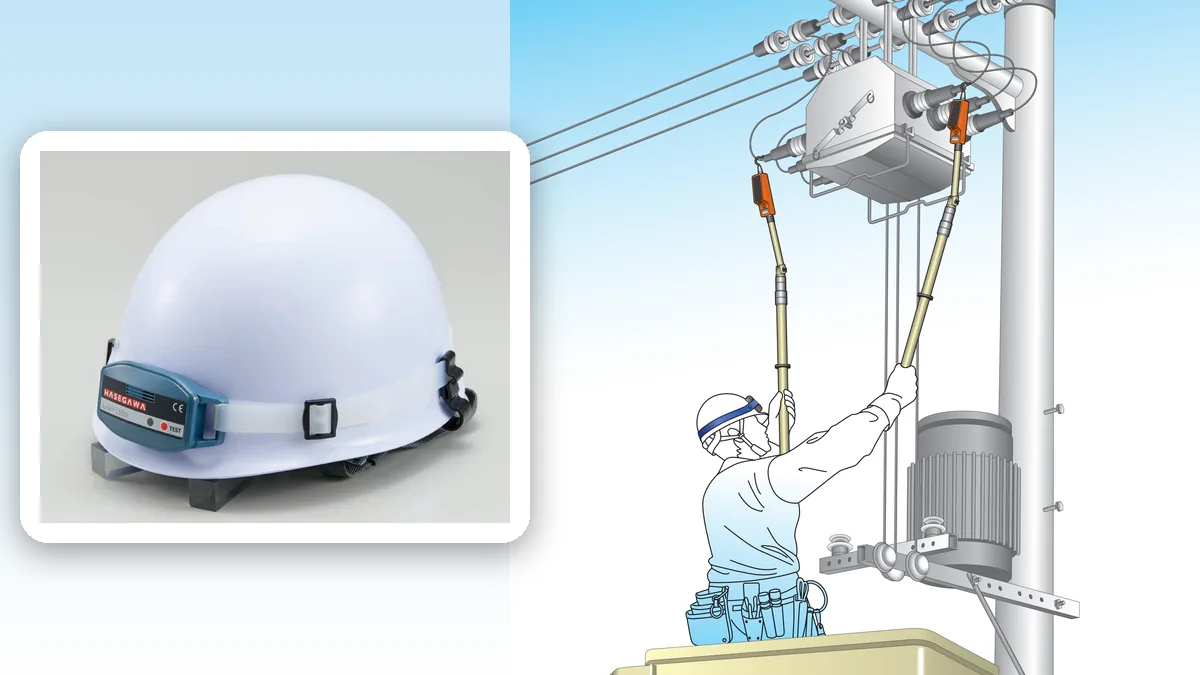
A helmet-mounted proximity alarm is a personal safety device fixed to a safety helmet that gives an audible and visual warning when the wearer's head comes dangerously close to an energised overhead line conductor. The right model is chosen by the voltage class of the lines your crew works on: the HASEGAWA HXA Series offers the HXA-6S for 6.6 kV – 33 kV, the HXA-30S for 11 kV – 66 kV and the HXA-70S for 66 kV – 110 kV.
This guide explains how a helmet alarm works, which model suits which network, the theoretical alarm distances from the current HXA Series catalogue and how to use the device correctly in the field. For the general principle and a comparison of wrist, arm and helmet types, see What Is a Proximity Alarm?.
What does a helmet-mounted proximity alarm do?
On a pole top, in an elevated work platform or on a tower, a line worker's attention is on the task in hand. A circuit left energised above or beside the isolated one, a neighbouring line or a conductor at risk of back-feed may be within reach. Approaching it unnoticed while climbing, turning or looking up is one of the most serious hazards of overhead line work.
A helmet alarm is designed to catch that moment. Because it sits on the helmet:
- The warning comes from the head and shoulder area, one of the zones that most often approaches the conductor on overhead work.
- Both hands stay free; the alarm keeps working while the worker holds tools, a hot stick or a rope.
- The sound source is close to the ear, so the warning is noticed even in wind and noise at height.
- It goes on and off with the helmet, so it is rarely left behind in the van.
How does it work?
An overhead conductor energised with alternating voltage creates an electric field proportional to its voltage. The HXA Series monitors the strength of that field without contact. As the helmet gets closer the field grows; once the threshold is exceeded, the buzzer sounds and the LED flashes. No contact with the conductor is needed.
Two practical consequences follow:
- Alarm distance depends on voltage. The higher the line voltage, the stronger the field and the further away the alarm starts.
- Surroundings change the distance. Conductor arrangement, earthed poles and cross-arms and other nearby circuits can screen or distort the field. Catalogue values are therefore theoretical references under standard conditions.
Why the HXA Series?
According to the current HXA Series brochure, the helmet-mounted models offer:
- Audible and visual warning: buzzer plus flashing LED; sound level at least 65 dB at 1 m.
- No power switch: always on standby, so it cannot be left switched off.
- IP67 dust and water protection (IEC 60529): dust-tight and protected against temporary immersion.
- Long standby life: about 1 year on standby and about 15 hours of continuous alarm from a single CR2032 battery.
- Light body: about 45 g, hardly noticeable on the helmet.
- International references: the brochure lists EN 61326-1 Class B, CISPR 11:2015, EN 61010-1, IEC TR 61243-6 and ASTM F3283/F3283M-18, and the series has passed EMC testing.
- Made in Japan under strict quality control.
Which model for which network?
The basic rule: the model's operating range must cover the voltage of the lines the crew works on.
| HXA-6S | HXA-30S | HXA-70S | |
|---|---|---|---|
| Operating voltage | AC 6.6 kV – 33 kV | AC 11 kV – 66 kV | AC 66 kV – 110 kV |
| Typical use | 10 kV, 20 kV and 33 kV distribution | 20 kV – 66 kV lines | 66 kV – 110 kV lines |
| Warning | Audible + flashing LED | Audible + flashing LED | Audible + flashing LED |
| Protection | IP67 | IP67 | IP67 |
| Battery | CR2032 × 1 | CR2032 × 1 | CR2032 × 1 |
| Weight (body) | approx. 45 g | approx. 45 g | approx. 45 g |
Practical choice for European networks
- 10 kV, 20 kV and 33 kV distribution lines: the HXA-6S covers all three and gives the earliest warning on medium-voltage lines.
- Crews moving between 20–33 kV and 66 kV sub-transmission: the HXA-30S covers 11 kV – 66 kV in one device.
- 110 kV lines: the HXA-70S.
Theoretical alarm distances by line voltage
The HXA Series catalogue gives these theoretical alarm distances by line-to-line voltage:
| Line voltage | HXA-6S | HXA-30S | HXA-70S |
|---|---|---|---|
| 6 kV | 1.1 m | 0.7 m | 0.6 m |
| 11 kV | 1.4 m | 1.0 m | 0.8 m |
| 22 kV | 2.0 m | 1.4 m | 1.2 m |
| 33 kV | 2.5 m | 1.7 m | 1.5 m |
| 66 kV | 3.5 m | 2.3 m | 2.1 m |
| 110 kV | 4.5 m | 3.0 m | 2.7 m |
A model set to a lower voltage class warns earlier on the same line. Choosing a model far below the line's class is not the answer either: an alarm that sounds constantly well outside the working zone trains crews to ignore it. Match the model to the voltage class.
The values are theoretical. Real alarm distance varies with conductor arrangement, surrounding structures, earthing conditions and the work environment, and operation should be verified on site. An alarm distance is never a minimum approach distance; the distances in your work plan and in EN 50110-1 based procedures always apply.
Helmet, arm or wrist?
HASEGAWA proximity alarms are worn in three positions. The right one depends on the task and on which part of the body is most exposed:
| Type | Worn on | Best for |
|---|---|---|
| Helmet (HXA-6S/30S/70S) | Safety helmet | Pole-top, tower and platform work; climbing |
| Arm (arm proximity alarms) | Upper arm | Overhead work where the arms reach towards the conductor |
| Wrist (HXW-6W) | Wrist | MV switchgear and panel work |
For overhead line crews, a helmet unit keeps the alarm in the same position and independent of the hands. Inside MV switchgear the hand reaches live parts before the head, so the wrist-worn HXW-6W gives the more relevant warning. Many crews carry both; we describe that combination in Voltage Safety Kit for Field Crews.
Fitting and daily routine
- Position it correctly. Fix the unit to the helmet with the supplied band and two holders so the sound is not blocked, and check that it does not slip during work.
- Test at the start of each shift. There is no power switch; press the test button to confirm the audible and visual warning. If there is no warning, do not use it and check the battery.
- Plan battery changes. One CR2032 gives about a year on standby; long alarm periods shorten that. Keep a spare in the crew kit.
- Stop when it sounds. Never dismiss a warning as a false alarm. Stop, step back and identify the live part again.
- Make it part of the checklist. Adding "helmet alarm fitted and tested" to the pre-job briefing turns the device into crew routine.
Limits of use
- A helmet alarm is an auxiliary warning device; it does not prove absence of voltage. Verify the line is dead with a detector rated for its voltage. On 11 kV – 33 kV overhead lines the HWA-33X, which also gives a two-stage approach warning, is a strong companion.
- A silent alarm does not mean the conductor is dead or that you are at a safe distance.
- It does not replace isolation and locking, earthing, insulating gloves or other PPE. See The Five Safety Rules for Electrical Work.
Frequently Asked Questions
What does a helmet-mounted proximity alarm do?
Fixed to a safety helmet, it senses the electric field of an energised overhead conductor and gives an audible and visual warning when the wearer's head comes dangerously close, reducing the risk of approaching a live line unnoticed.
Which HXA model suits 20 kV networks?
The HXA-6S (6.6 kV – 33 kV) covers 10 kV, 20 kV and 33 kV distribution lines. Crews that also work on 66 kV lines can use the HXA-30S (11 kV – 66 kV).
Can a helmet proximity alarm be used in rain?
Yes. The HXA Series is rated IP67: dust-tight and protected against temporary immersion in water.
Does it have an on/off switch?
No. The HXA Series is always on standby and lasts about a year on a single CR2032 battery. A test-button check at the start of each shift is enough.
Does a helmet alarm replace a voltage detector?
No. A proximity alarm only warns. Absence of voltage must be verified at the work location with a voltage detector rated for the system voltage.
Tell us the voltage levels your crews work on through our quotation form and we will help you choose between the HXA-6S, HXA-30S and HXA-70S. See all models in helmet proximity alarms. HASEGAWA Türkiye, the official distributor in Türkiye, supplies genuine HASEGAWA products to customers across Europe.
Sources
- HASEGAWA HXA Series – Hot Line Proximity Alarm product brochure (manufacturer)
- IEC 60529 – Degrees of protection provided by enclosures (IP Code) (IEC Webstore)
- EN 50110-1 – Operation of electrical installations (CENELEC)