The Five Safety Rules for Electrical Work: Working De-energised

Disconnect, secure, verify dead, earth and short-circuit, protect against adjacent live parts: what the five safety rules mean on site, with a checklist and the reconnection sequence.
The five safety rules are the five steps applied in order so that work can be carried out safely on an installation that has been made dead: disconnect completely, secure against re-connection, verify that the installation is dead, carry out earthing and short-circuiting, and provide protection against adjacent live parts. The sequence is defined in the European standard EN 50110-1 (Operation of electrical installations) and is widely known simply as "the five safety rules". Their value comes from applying them together and in the right order, not one at a time.
In this article we look at what each step means on site, how the rules are reflected in European safety guidance, a checklist you can use before starting work, and the sequence to follow when re-energising the installation at the end of the job.
What are the five safety rules?
As set out in EN 50110-1 and reproduced in the same order in manufacturer and safety-body literature, the five rules are:
- Disconnect completely
- Secure against re-connection
- Verify that the installation is dead
- Carry out earthing and short-circuiting
- Provide protection against adjacent live parts
The current edition of the standard is EN 50110-1:2023. In Germany, for example, it has been published as DIN EN 50110-1 (VDE 0105-1):2024-11. Check your national standards body for the edition that applies in your country.
How are the rules applied in European practice?
The rules do not stand alone; they sit inside an organised work procedure. A "Five Safety Rules" leaflet published by the ISSA Electricity Section (hosted by the German BG ETEM) lists the crucial requirements before starting work in a de-energised state, including:
- A person responsible for the installation and a person in control of the work activity are nominated, and both are competent to carry out the planned work safely.
- Work is co-ordinated with other enterprises working on site, and provision is made for rescue in an emergency.
- A written permit for the working area should be issued, for example when several enterprises are involved.
- Adjacent areas with energised parts are identified.
The same leaflet states that equipment is regarded as de-energised only once all five rules have been complied with, and that as soon as one of these safety measures is cancelled, all de-energised parts must be regarded as live again.
In the United Kingdom, HSE guidance HSG85 (Electricity at work: Safe working practices) describes the same dead-working sequence: isolate and secure the isolation, post notices, prove dead, earth, and protect against adjacent live parts. On high-voltage systems it recommends that an electrical permit-to-work is issued, but only after all of these precautions have been taken.
What does each step mean on site?
1. Disconnect completely
Identify all sources that can feed the section to be worked on: the main supply, ring or standby supplies, generators, UPS, capacitor banks, and possible backfeed through voltage transformers. After the circuit-breaker is opened, the disconnector that provides a visible or reliable isolating gap is also opened. A circuit-breaker being open is not, on its own, enough for the section to count as "isolated".
2. Secure against re-connection
Isolating devices are locked off (LOTO), warning notices are posted, remote control is disabled, and fuses are removed and kept safe. Where several people are working, a multi-lock hasp or lock box on which each worker fits their own padlock ensures that the installation cannot be energised until the last lock has been removed.
3. Verify that the installation is dead
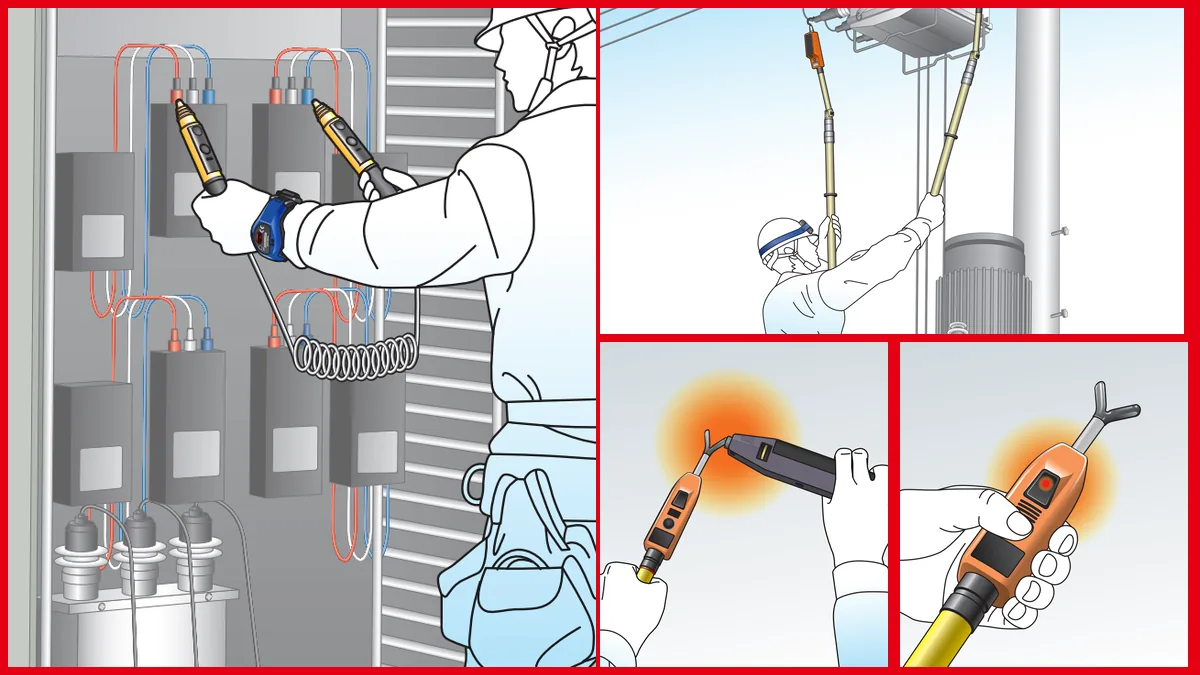
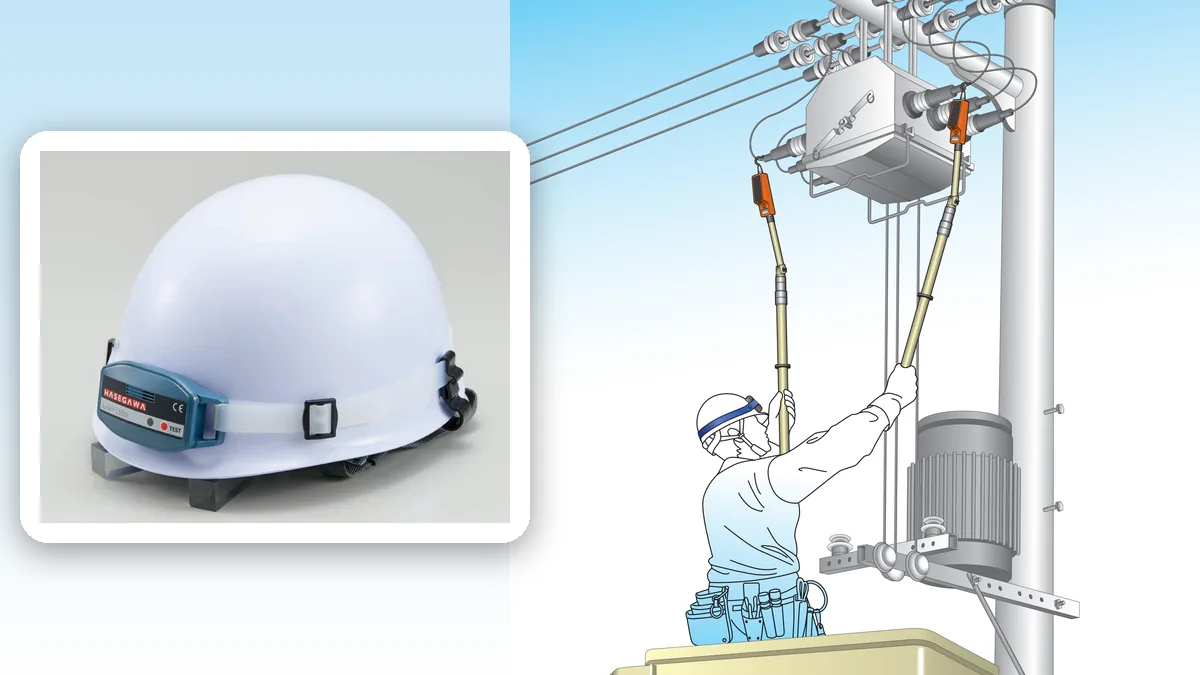
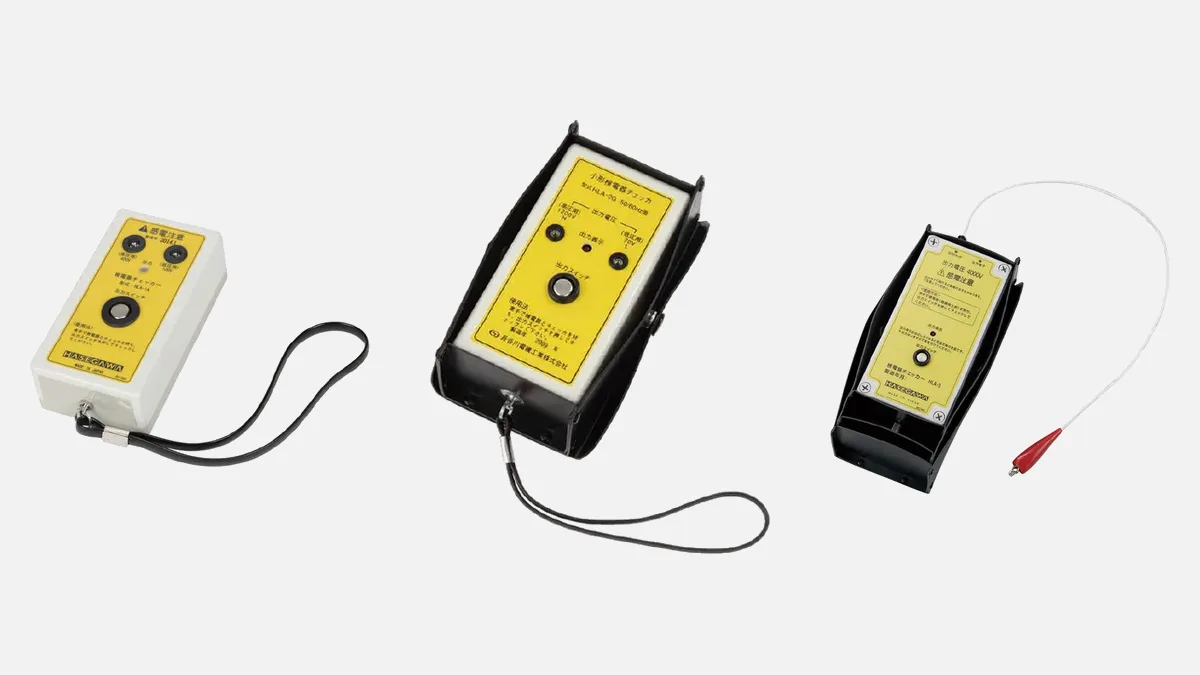
This is done with a voltage detector suited to the system voltage, at the point of work and on all phases. The detector itself must be tested immediately before and after use with a tester or a known live source; otherwise a faulty detector showing "no voltage" is the most dangerous possible error. HSG85 makes the same point: the instrument must be tested before and after use. For capacitive detectors used on medium and high voltage, the international reference is IEC 61243-1. We explain how to choose the right detector in our voltage detector selection guide.
4. Carry out earthing and short-circuiting
Immediately after the dead state has been verified, the earthing set is connected first to the earthing system, and then to the phase conductors using an insulated earthing stick. The earthing and short-circuiting device should be visible from the work location. HSG85 adds that earths are usually applied at all points where the circuit is isolated from the supply, and that additional local earths at the point of work may be needed if it is remote from the point of isolation, applied only after proving dead there. Earthing and short-circuiting at the work location keeps the section de-energised for the duration of the work in the event of interference (induced) voltages, atmospheric overvoltages or accidental re-connection; for equipment that stores charge, such as cables and capacitors, it is essential. A discharge stick is also used for residual charge on cables and capacitors. We cover set selection, cross-section and clamps in our earthing sets article.
5. Provide protection against adjacent live parts
If busbars, cubicles or lines near the work area remain live, the risk of contact is removed with insulating covers, barriers, partitions or continuous supervision. If this is not possible, the adjacent section should also be made dead.
Checklist before starting work
| Step | What to check on site | Equipment used |
|---|---|---|
| 1. Disconnection | Have all supply directions been identified? Are the circuit-breaker and disconnector open? | Single-line diagram, operating rod |
| 2. Securing | Is the lock fitted and the key held by the responsible person? Is the warning notice posted? | Padlock, multi-lock hasp, notice |
| 3. Verification | Was the detector tested before and after? Were all phases checked? | Voltage detector, voltage detector tester |
| 4. Earthing | Was the set connected to earth first? Is it visible from the work location? Has residual charge been drained? | Earthing set, discharge stick |
| 5. Adjacent parts | Have nearby live parts been covered or fenced off? | Insulating cover, barrier, proximity alarm |
This table is a general framework; every organisation should adapt it to its own installation and permit-to-work procedure.
What sequence is followed when re-energising after the work?
When the installation is to be re-energised, the five steps are undone in reverse order. The ISSA leaflet lists the reconnection steps as follows:
- Ensure all workers have reported that their work is complete, and that all tools, equipment and devices have been removed from the work site.
- Inform all workers that the work permit is cancelled and the equipment is about to be re-energised.
- Remove the earthing and short-circuiting devices. In general practice the set is removed in the reverse of the connection sequence: from the phase conductors first, and from the earth connection last. Temporary covers and barriers placed for adjacent parts are also removed.
- Remove locks, notices and tags.
- Re-energise the equipment, on the instruction of the responsible person.
Most common mistakes
- Not opening or locking the disconnector because the circuit-breaker is already open.
- Accepting an indicator lamp or a meter reading zero as proof of "no voltage".
- Not testing the detector before use, or using a detector unsuitable for the voltage level.
- Connecting the earthing set to the phase first and to earth afterwards.
- Ignoring residual charge on cables and capacitors.
- Not accounting for backfeed sources (generators, ring circuits, voltage transformers).
Where is HASEGAWA equipment used in the five safety rules?
Three of the five steps directly require equipment. For verifying the dead state, HASEGAWA voltage detectors are available for levels from low to high voltage, and voltage detector testers are used to check detectors before use. For earthing and short-circuiting, cubicle earthing sets are used in MV switchgear, and discharge sticks for residual charge on cables and capacitors. On sites with adjacent live parts, proximity alarms can provide an extra layer of warning; but no device replaces the five rules.
Related guide: safe working in medium-voltage switchgear.
Frequently Asked Questions
Which standard are the five safety rules based on?
The five safety rules are defined in EN 50110-1, the European standard for the operation of electrical installations. Safety bodies such as the ISSA Electricity Section and the UK HSE (in HSG85) describe the same sequence.
Can the order of the rules be changed?
No. For example, connecting an earthing set to a phase without first checking for voltage creates a serious short-circuit and arc risk if the conductor is live. The sequence is built so that each step relies on the safety of the one before it.
Is earthing also necessary at low voltage?
Not in every case. According to HSE guidance HSG85, earthing low-voltage equipment is desirable where there is a risk of re-energisation, for example from a generator under someone else's control. In other low-voltage equipment it may be physically impractical, or introducing an earth near adjacent live parts may create a short-circuit risk that outweighs the benefit. The decision should be made through a risk assessment.
Can the absence of voltage be verified without a voltage detector?
No. Indirect signs such as indicator lamps, meter readings or a transformer falling silent are not sufficient. The check must be made on every phase with a detector suited to the voltage level and tested before use.
If you would like to identify the voltage detectors, earthing sets or discharge sticks your team needs, contact us via the quote form.
Sources
- DIN Media – DIN EN 50110-1, Operation of electrical installations, EN 50110-1:2023
- ISSA Electricity Section / BG ETEM – Five Safety Rules: Working in a de-energised state (leaflet)
- DEHN – Safe Working on Electrical Installations: Earthing and Short-Circuiting Devices (DS191/E)
- HSE – HSG85 Electricity at work: Safe working practices (3rd edition, 2013)
- IEC 61243-1:2021 – Live working, Voltage detectors, Part 1: Capacitive type