What Is a Discharge Stick? Draining Residual Charge Safely
De-energised cables, capacitors and equipment under test can store a dangerous charge. We explain what a discharge stick does, the main types and how to use one correctly.
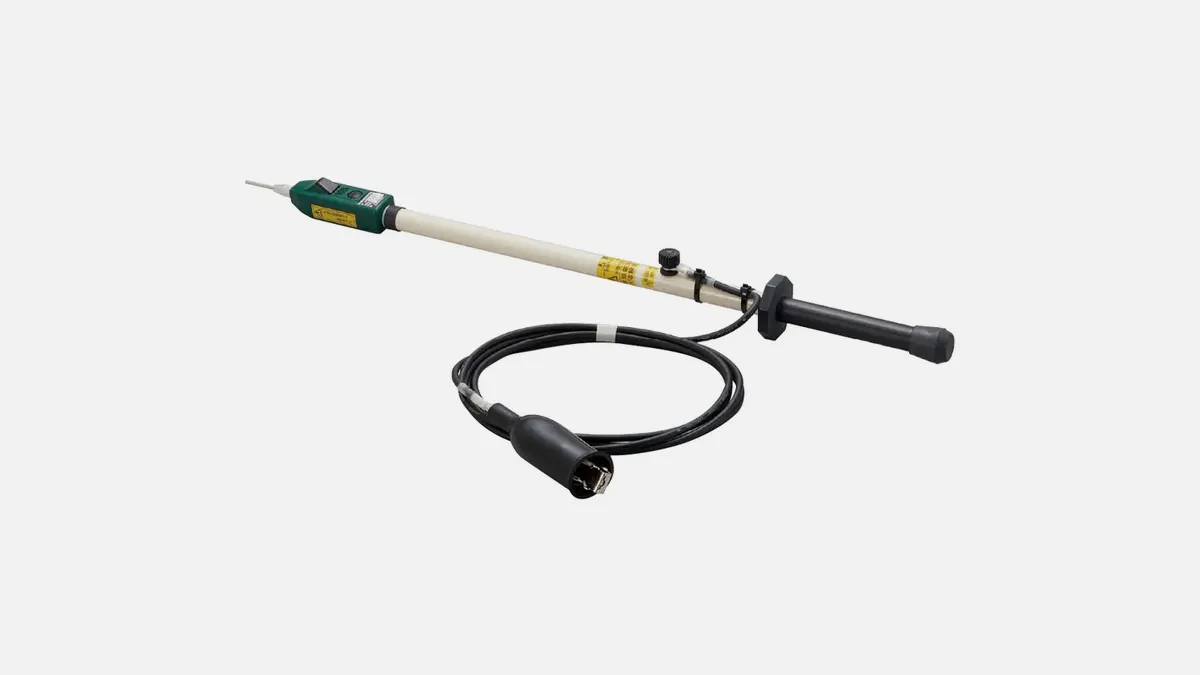
Switching off a piece of equipment does not mean that no dangerous voltage remains on it. Power capacitors, long medium-voltage cables and equipment that has undergone a withstand (insulation) test can store a significant electrical charge after the supply has been disconnected. A discharge stick is an insulated hand tool used to drain this residual charge safely to earth.
When is a discharge stick used?
- Before maintenance on power capacitor banks
- After insulation or withstand testing of medium- and high-voltage cables
- When changing specimens in test laboratories
- Before disconnecting or jointing long cable runs
Types of discharge stick
| Type | How it works | When to choose it |
|---|---|---|
| Built-in resistor | The charge is drained in a controlled way through a limiting resistor | Applications where the initial discharge current must be limited |
| Sound-and-light indicator | Gives an audible and visual signal when discharge is complete | When it must be clearly seen that the charge has fully drained |
| Simple (direct) | Direct connection to earth | Made to order for specific applications |
In the HASEGAWA range:
- HRD-27 – built-in resistor type, maximum discharge voltage DC 27 kV
- HRD-27S – indicates with sound and light that the stored charge has fully drained, maximum discharge voltage DC 27 kV
- Made-to-order simple discharge stick
All models: discharge sticks.
Correct use, step by step
- Confirm that the supply to the equipment has been disconnected and that the disconnectors are open.
- Connect the discharge stick's earth lead to a reliable earth point first.
- Wearing suitable personal protective equipment, hold the stick only by its insulated handle.
- Touch the tip to the conductor to be discharged; with resistor types, wait for the time recommended by the manufacturer.
- On models with an indicator, wait for the signal that discharge is complete.
- Keep the conductor earthed for the duration of the work, and remember that charge can build up again on capacitors.
Common mistakes
- Connecting the earth lead last, or not at all.
- Using a stick whose maximum discharge voltage is lower than the voltage in the application.
- Leaving the conductor unearthed after discharging.
Is a discharge stick the same as an earthing set?
No. A discharge stick drains residual charge; earthing sets keep the line earthed (grounded) throughout the work and protect against accidental re-energisation. In most applications the two are used together.
Frequently asked questions
Does a discharge stick need periodic inspection?
Yes. The insulating body, earth lead and connection points should be visually checked before every use, and periodic testing should be carried out in line with the manufacturer's recommendations.
Which discharge voltage rating should I choose?
Choose a model that covers the highest voltage that may be present on the system to be discharged. If you are unsure, contact us and we will help you identify the right model for your application.