How to Use the HXW-6W Wrist Alarm: Wearing, Testing and Battery Guide
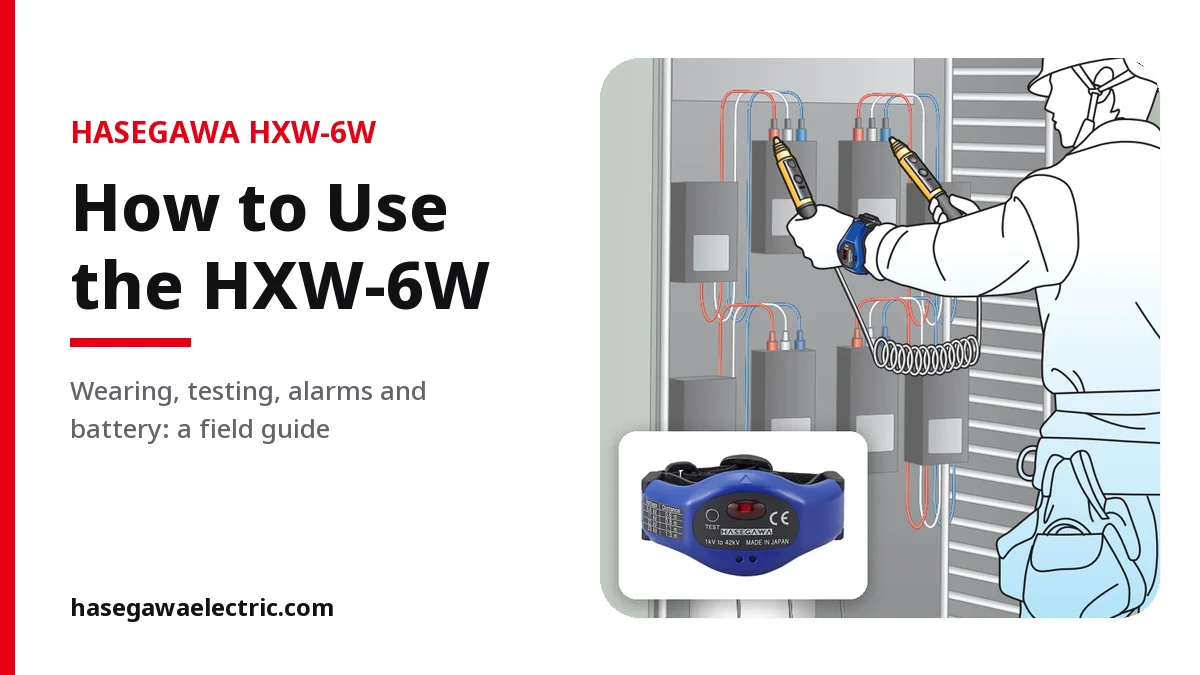
How to wear the HASEGAWA HXW-6W wrist alarm, how to test it before work and what to do when it sounds. A practical guide to correct use, battery and care.
The HASEGAWA HXW-6W is a voltage detection alarm worn on the wrist like a watch; it sounds when the wearer approaches a live part. Using it correctly comes down to three steps: check it with the TEST button before every job, wear it on the wrist of the working hand with the detecting face towards the fingertips, and keep it on until the job is finished. The HXW-6W is an auxiliary warning device; absence of voltage is always proven with a suitable voltage detector.
This guide explains how to wear the HXW-6W on site, how to test it before each job, what to do when it alarms, and how to look after the battery.
What the HXW-6W does and does not do
The HXW-6W senses the surrounding electric field without contact. When the wearer approaches a live conductor in the AC 1 kV – 42 kV range, it gives an audible alarm of at least 65 dB; at 6.6 kV the theoretical alarm distance is about 60 cm. A worker who unknowingly moves towards a live busbar or a neighbouring panel is warned even while both hands are holding tools.
Limits to keep in mind:
- It is not a voltage detector. A silent alarm does not mean "dead". Absence of voltage is proven with a voltage detector.
- Distances are theoretical. The manufacturer's figures apply under standard conditions; a nearby earthed structure, the conductor layout or the wiring can shorten them.
- Sensitivity is directional. Sensitivity is lower at the back of the device, which on the wrist is the direction of the palm.
1. Make sure you have the right model
The HXW-6 series has two models. Use the HXW-6W (AC 1 kV – 42 kV) in medium-voltage switchgear and on 10 kV, 20 kV and 33 kV distribution networks, and the HXW-6WL (AC 400 V – 22 kV) in low-voltage panels. Because the HXW-6WL is tuned for low voltage, it may start alarming at an unnecessarily long distance in medium-voltage installations; use the HXW-6W for MV work.
2. Test it before every job
Before each job, and before putting it on, press the TEST button and check that the alarm sounds. If there is no sound or it is weak, replace the battery and test again. If the test still fails, do not use the device.
A good habit is to test as a team: during the pre-job briefing everyone tests their alarm out loud and the result is noted on the work permit.
3. Wear it correctly: working hand, right direction
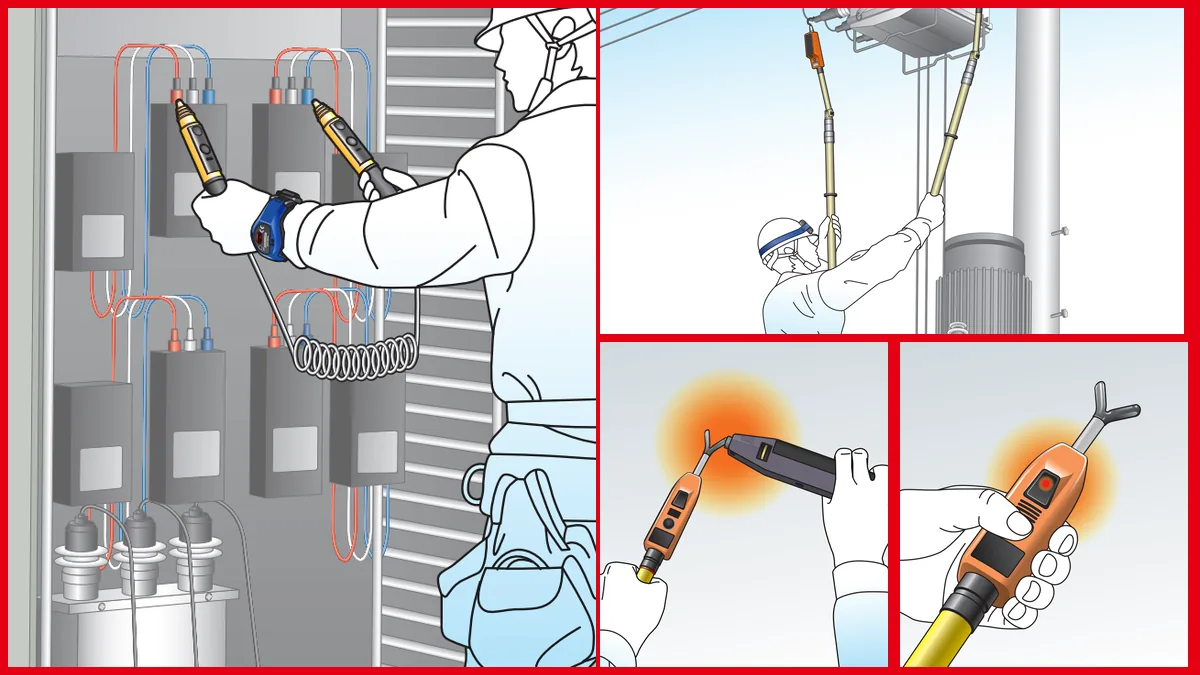
- Wear the alarm on the wrist of the hand that reaches forward while working; for most workers this is the hand holding the tool.
- The face of the device should be on the back of the hand. Detection is easier towards the fingertips and to the sides; the detection distance is shorter towards the palm.
- Fasten the strap over the glove cuff and sleeve, tight enough that the device does not slide. An alarm hidden under a sleeve can sound muffled.
- Keep the alarm on until the job is finished. With a switchgear door open, sections next to the isolated feeder may still be live.
4. What to do when it alarms
The alarm means your hand is approaching a live part. Then:
- Stop and pull your hand back until the alarm stops.
- Check where you are. Confirm again that you are at the right panel and feeder and that the section named on the permit is really isolated.
- Verify with a voltage detector. Test for absence of voltage on the suspect section with a detector rated for that voltage.
- Stop the job if needed. If the section is live, tell the person in charge; do not continue until the five safety rules are complete.
Never dismiss an alarm on a section you believe is dead as a "device fault". Opening the wrong panel or back-feed are exactly the mistakes this warning is designed to catch.
5. Battery and care
- Battery: one CR1620 (3 V) coin cell. A new battery lasts about 15 hours in continuous operation and about 10 months when the device is not in use.
- Keep a spare battery in the field bag and replace it as soon as the test sound is weak.
- Operating temperature: −10 °C to +40 °C. Battery performance can drop in severe cold; repeat the test on site in winter.
- The device is waterproof; still, clean it after use and store it in a dry place.
- Do not use a device that has been dropped hard, has a cracked case or stays silent in the test.
Theoretical alarm distances (HXW-6W)
| Line voltage | Theoretical alarm distance |
|---|---|
| 6.6 kV | 0.6 m |
| 11 kV | 0.8 m |
| 22 kV | 1.1 m |
| 33 kV | 1.3 m |
These are the manufacturer's theoretical values under standard conditions. Confirm the actual operating distance in the real working environment before use.
Checklist: before starting work with the HXW-6W
- Right model: HXW-6W for medium voltage
- Alarm checked with the TEST button
- Worn on the working hand, face on the back of the hand
- Suitable voltage detector and detector tester at hand
- Spare CR1620 battery in the bag
For technical details see the HXW-6W product page; for the device category in general see our guide to wrist-worn voltage proximity alarms.